

Time – the sense of not having enough of it – has played a defining role in my life. I’ve written of this previously : its origins and my attempts to counter the discomfort. On the latter, I’ve developed a new practice for myself. I’m walking in circles, every morning, after my stretching and sitting practice, I go outside and set my timer for longer than feels comfortable and walk a small circle of about 15 paces in circumference.
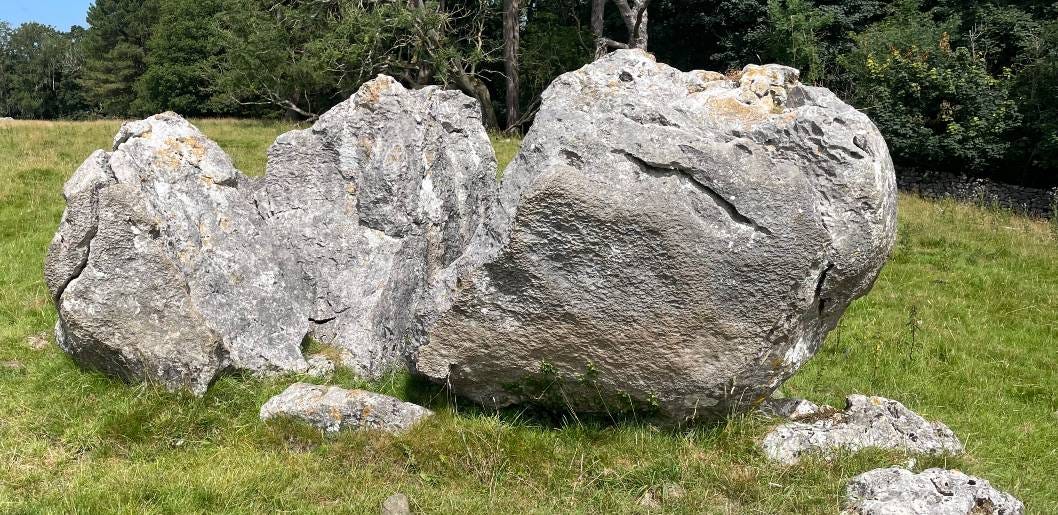
I’m lucky to live alongside a limestone escarpment and have begun an almost daily practice of walking on top of this ancient rock of dead sea creatures, a virile fig tree and various brief bloomings of (currently) herb Robert, nipplewort and slender St John’s wort. I walk in small circles, in the same place same direction and for between 30-90 mins. This circle walking is an opening of time. The small circles, round and round and round, a reminder of how much of [my] human life is a walking in circles. I watch the fleeting flight of birds, scuttle of insects, my walking in in the presence of the rock which was once sea bed, once equatorial and now rising, incrementally, here on the edge of Morecambe Bay.
This practice touches on one of the Buddhist doors of liberation: Aimlessness, which is intended to remind us that what we want we already have: the future is a seed in the present of my body. Aimlessness tests me. I’m inviting myself to resist jumping into the doing that is my default mode. I am deferring to the time of the rock – as much as I can – to that of blackbird or herb Robert. I am trying to remind myself that time is flexible and not the rigid master I have grown up being anxious of.
When we lived right by the sea we would fetch washed up tree trunks, carry them home to chain saw up, chop into burnable sizes then stack them in a shed. Sometimes we could spend a morning collecting and storing enough wood to last us several months through the winter. I never timed the work in the way I might time work that was going to earn my money. I never equated how many hours of money work I had saved by collecting the wood. It was simply a task we set ourselves, a gathering of the gifts of the sea and land, that had the reward of warming us four times over: the collecting, the sawing, the chopping then the burning of wood.
Not being classically educated, I was only recently introduced to ‘Kairos’, the more sociable, tender cousin to the Greek concept of ‘Chronos’. I knew Chronos from being blown away by Guillermo del Toro’s film of the same name : the clock-ticking time of our society where ‘time is money’ and ‘killing time’ or ‘hurry up please, it’s time’ etc etc.
As Rebecca Tamás says in her recent Caught by the River interview about her new book, (and I’m paraphrasing): when you start off thinking you’re being cutting edge, it becomes sadly inevitable that by the time you’ve articulated your thinking, it’s mainstream (perhaps a social form of kairos). So I shouldn’t be surprised that when I went to double check my understanding of kairos, I discovered this Guardian article on it from just four days ago.
For me, kairos reinforces a way of living that trusts my opportunistic decision making, that is to live with the phrase given to me by artist Caroline Pick, which ought to be a Zen Crone but for reasons beyond my comprehension isn’t : Your Timing is Always Perfect.
Because, of course, ‘perfect’ might not be what we want, but how the great collective moment assembles itself. Kairos, for me, is understanding how I might settle into / live with this greater collaboration that is any given moment: how I am walking in circles on the millennia old planktonic limestone with the herb Robert and Nipplewort today and the ripe figs next week.
In the Guardian article Kelley Swain refers to blooming and ripening, which are words also used by Zen master Thich Naht Hanh. In his translations of The Buddha’s teachings he uses the phrase ‘ripening in every moment’ for one of the Plum Village’s Dharma seals. There is a talk on that here. In short, this ripening is to encourage us to no expect / demand / live to seeing instant results, rather to recognise that things come to fruition at different times, with different conditions, in different forms and different places.
This remembering of ripening feels particuarly pertinent for me as I return to my ancestral memoir manuscript - begun in 2022 - to try and understand what it is, and so how it find a home in the world. Part of me (ego, hello) feels terribly frustrated and wearied at the process. Why can’t someone just see what it is for me? This is countered by the quieter, somehow more insistant voice that understands the work that needs to be done, that patiently returns to the work and sits with it, diligently, and considers it.
It is a lesson in the immeasurable nature of time when with someone or thing you love.
And perhaps timely enough I’ve just finished Helm - the first Sarah Hall book I’ve enjoyed enough to finish. In the acknowledgements she writes tat this book took her about twenty years to write.
The book I’ve just begun is Annie Dillard’s The Writing Life . In this she writes, ‘It takes years to write a book—between two and ten years. Less is so rare as to be statistically insignificant. One American writer has written a dozen major books over six decades. He wrote one of those books, a perfect novel, in three months. He speaks of it, still, with awe, almost whispering. Who wants to offend the spirit that hands out such books? Faulkner wrote As I Lay Dying in six weeks; he claimed he knocked it off in his spare time from a twelve-hour-a-day job performing manual labor. There are other examples from other continents and centuries, just as albinos, assassins, saints, big people, and little people show up from time to time in large populations. Out of a human population on earth of four and a half billion, perhaps twenty people can write a serious book in a year. Some people lift cars, too. Some people enter week-long sled-dog races, go over Niagara Falls in barrels, fly planes through the Arc de Triomphe. Some people feel no pain in childbirth. Some people eat cars. There is no call to take human extremes as norms.’
This makes me smile. Reminds me of my friends who came to Giggleswick last year and spoke of how they were returning with the same manuscript as the previous year to spend the week with.
My adoption of retiming will be, for someone as impatient as myself, a lifelong practice – which maybe continue to include walking in circles, literally and figuratively. And to help me work through this in terms of my writing, and how it might feed my work, and the ideas within it, I think the next Imaginarium will be Imaginarium Time, there’s plenty to explore, from our own sense of time as a writer to how time features in what we write. This will be a January start, so keep your eyes out for news of that in the autumn.
Books I’ve not yet read on time are
Todd Wassle’s Walking in Circles: Finding Happiness in Lost Japan
Jenny Odell’s Saving Time: Discovering Life Beyond the Clock
Rebecca Tamás’s The Book of Mysteries: Wild Time and the Ritual Year
I’d be interested to add to this list, if you have any to recommend
What about Pip Pip: A Sideways Look at Time - Jay Griffiths ?